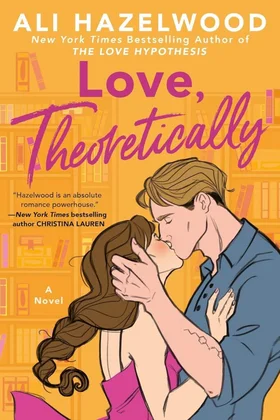
Love, Theoretically is a grumpy‑sunshine romance set deep in the world of academia. A heated rivalry filled with office politics and angsty chemistry all collide in the best way. It follows Elsie, a theoretical physicist who’s juggling too many jobs, too many expectations, and way too many people‑pleasing, as she crashes headfirst into Jack Smith - an experimental physicist with a reputation for being blunt, intimidating, and impossible to read.
Plot Points
The book opens with Elsie Hannaway, a theoretical physicist who’s juggling way too much: a barely paid adjunct job, a fakedating side hustle and the constant pressure of trying to prove herself in a field that doesn’t particularly welcome her (or women in general). From the first chapter, you get this interesting mix of academic chaos and that well-known humour that Ali Hazelwood is known for. Things kick off when Elsie has an interview for her dream job at MIT, as well as a well-needed chance at stability, and immediately runs in Jack Smith, a grumpy and intimidating experimental physicist who also happens to be the older brother of one of her long‑term fakedating clients. Their first interactions are filled with awkwardness in the best way, full of misunderstandings and tension, but you can subtly feel the slow-burn spark form as they try very hard to pretend it’s not there. From there, the story blends academia drama, messy professional politics, and the emotional fallout of constantly feeling underestimated. Themes of identity, self‑worth, and the pressure to be “likable” run through the whole book, along with the idea of choosing what you actually want instead of what looks good on paper. It’s got that signature Hazelwood mix of nerdy banter, vulnerability, and a romance that builds in tiny, satisfying increments.
Writing Style
The writing style in Love, Theoretically is exactly what you’d expect if you’ve read her before, but this novel definitely had the most academia-centered plot. It focuses heavily on Elsie’s imposter syndrome and her mentality going through the book, which added a layer of emotional depth that felt more complex than in her other books (although that may be due to my own experiences with academia). It definitely resonated deeper with me than the struggles of the main characters in her other books. It’s casual, and super character-driven and Ali Hazelwood leant hard into internal monologue, especially during Elsie’s spirals, which makes the book feel funny and chaotic but also surprisingly vulnerable. There’s a nice balance between the science‑y details (which she keeps digestible even if you don’t know a thing about physics) and the softer, more introspective moments where Elsie starts questioning who she is when she’s not trying to please everyone around her. The dialogue is snappy, the pacing is fast, and the romantic tension builds in that slow‑burn, “I’m pretending I don’t care but I absolutely do” way that is typical of the beloved author. Overall, the writing feels warm and emotionally honest - light enough to breeze through, but grounded enough that certain lines stick with you.
What I Loved
One of the things Love, Theoretically does really well is using academia as more than just a backdrop. The physics department politics, the petty (and pathetic) rivalries combined with the constant pressure to be better. It all feels real without ever taking away from the story it’s trying to tell. This book manages to balance the fun, nerdy side of science, but she doesn’t shy away from the darker reality of being a woman in a field where you’re constantly underestimated or expected to be endlessly accommodating. Elsie’s whole identity shifts to what others need it to be, which can be really relatable, and watching her slowly realise she doesn’t have to keep performing for everyone is one of the most satisfying parts of the book. And then there’s the romance. The slow burn between Elsie and Jack is extraordinarily done. Every interaction feels packed with tension - the anxiety, the accidental glances, the unwanted sparks. You can practically feel the tension humming under the surface long before either of them admits anything. When things finally tip into spicy territory, the scenes are genuinely well written: not cringey, not rushed, just the right amount of payoff after all that build‑up (not that I would expect anything different from Ali Hazelwood). Combine that with the academic chaos swirling around them, and the whole thing becomes this addictive mix of nerdiness, vulnerability, and chemistry that really works.
What I Didn’t Love
For starters, I would have adored if this novel would have been a dual POV. I feel like having Jack’s thoughts would have made the ending feel more impactful. I would have loved it if some of Elsie’s spirals had been replaced with Jack’s POV on the situations at hand, as the fact I only see him through Elsie’s lens inhibits my ability to really fall in love with him as a character, rather than just as a love interest. Next, I can’t help but feel slightly conflicted about the ending. This book makes us root for Elsie to get with Jack, and for all of her problems to be solved, and it gives a release of dopamine when that does happen. However, I feel like the resolution feels slightly too clean compared to how brutal real‑life STEM environments can be. It’s satisfying, but definitely underwhelmed me as an individual who has been in those environments.
Recommendation
If you’re into romances that mix nerdy chaos with genuine emotional growth, Love, Theoretically is absolutely worth picking up. It’s a perfect fit for readers who love the slow-burn tension in academic settings. If you prefer dual POVs, or if anxious internal monologue isn’t your thing, you might find parts of this one a bit repetitive. And the ending wraps up cleaner than real‑life academia ever would. But if you’re here for smart banter, simmering chemistry, and a heroine learning to take up space in her own life, this is a satisfying, addictive read that delivers exactly what it promises. Beware to readers that do not enjoy spicy scenes in their books, this will not be the book for you.
Songs:
Songs I find reminiscent of the book:
Are you Satisfied? By Marina and the Diamonds
Mirrorball by Taylor Swift
Line Without a Hook by Rick Montgomery
Campus by Vampire Weekends
(P.S. We made them links so feel free to click on them and get teleported straight into the vibes.)