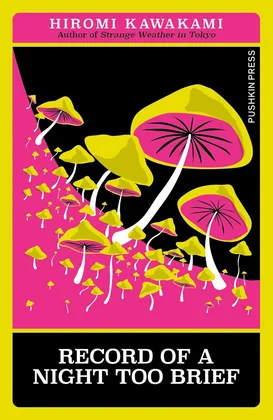
A Record of a Night Too Brief is a surreal, calmly unsettling collection that blends Japanese mythology, emotional undercurrents and symbolism. Across the three short stories, Kawakami Hiromi creates worlds that slip between the familiar and the impossible, using simple language to convey it all. The collection moves between the eerie, the tender, and the absurd, offering an experience that lingers long after you finish the book.
Plot Points
I will preface this review by saying that I am no way an avid reader (yet) of Japanese literature, or novellas by Kawakami Hiromi, so this review is coming from an outsider. I am definitely someone who will be reading more of these, but as of now, below is what I have gathered from my experience.
Story 1: The first short story, titled after the book itself, A Record of a Night Too Brief, drifts through the subconscious thoughts of a young woman trapped in an endless, surreal night. The narrative unfolds over nineteen short chapters. The odd‑numbered chapters follow her shifting, dreamlike journey as she moves through landscapes that feel both familiar and impossible, while the even‑numbered chapters slip into stranger, more fragmented vignettes that mirror the instability of her inner world. The even‑numbered chapters follow a woman with a porcelain girlfriend, a storyline that leans further into the surreal and highlights the instability of identity and desire within the dreamscape. I do believe the narrator in these chapters is the same, they have the same voice as well style of narration, but I almost wanted to read it as two different consciousnesses in the same mind. I will say the even-numbered chapters were my favourite in this story. I interpreted it as a harmful partnership. A relationship that is toxic and, borderline, abusive but they still stay because it’s comfortable and known. It’s easier to stay than to leave. The inclusion of the mystic, surreal aspects make it more palatable and interesting, and it was overall a good read.
Story 2: The second story - Missing - is set in a world more closely related to ours, but still holds stark differences. The main character is a young girl, whose older brother (brother No. 1) disappears. The family were in the middle of planning his wedding, and rather than call it off, they chose to make Hiroko (the wife-to-be) marry brother No.2 instead. The story discusses the validity and purpose of traditions, as well as how life continues after someone passes away. From there, the story leans into this strange mix of normality and quiet absurdity, where everyone around her treats the situation as if it’s simply the most practical solution. No one pauses to acknowledge how bizarre or painful it is; they just keep moving, as though swapping brothers is no different from changing a seat at the table. Through the girl’s eyes, you get this understated sense of how adults cling to tradition and routine even when those traditions stop making emotional sense, and how life has a way of smoothing over the gaps left by someone who’s gone. I, personally, reading this story, felt that the darker tones of the story were hinted at in ways that felt well-done. Hiromi Kawakami managed to balance all of these themes in 36 pages.
Story 3: The final story of this book is called ‘A Snake Stepped On’, and revolves around Hiwako Sanada, a young woman that works for an elderly couple (Mr. Kosuga and Nishiko) selling beads. The story begins when she is on her way to work, and she steps on a snake, which promptly morphs into a woman and appears grumpy. Throughout the 53 pages that this short story takes up, Hiwako notices snakes in the lives of those around her, most notably Nishiko, who has had her own snake for a long time. Hiwako’s snake claims to be her mother, but Hiwako continually fights this notion, leading to an ambiguous ending. I enjoyed this story, but the ending felt very sudden in comparison to the pacing of the rest of the book. I do feel like this was intentional. My interpretation of this book was in relation to the representation of snakes in Japanese mythology, where snakes often represent fertility. The snake pressures Hiwako - a single, independent young woman - to give in to society’s pressure; get married and have children, and yet she still resists.
Writing Style
Kawakami’s style in A Record of a Night Too Brief feels like someone talking to you while they’re half awake and just shooting off with whatever their brain throws at them, on the surface at least. The writing is straight-forward, nothing dramatic, but the situations she can perfectly describe are so bizarre that the simplicity makes them hit harder. Scenes melt and morph into each other with no warning, and nobody in these stories reacts like anything is strange, which somehow makes you more invested. It’s a calm, mind-boggling read that allows you to dig as deep into the words as you want. On the surface, it is surreal and simple, but a layer deeper, it is stuffed with mythologies and symbolism.
What I Loved
Although all the stories hold their own individually, the collection of them really makes it better. The second story, despite it being the shortest, was my favourite. Once I read it, I had to put the book down and sit in silence for a few minutes to comprehend my thoughts and ideas about the story. It targeted very dark topics, but left it up for the reader to interpret just how dark they wanted it to be, and it felt very tasteful for a story like this.
What I Didn’t Love
Obviously, this isn’t the normal type of book I read. Short-stories, in general, are something I aspire to read more of, but as for the here-and-now, are few and far between what I read. Then add the Japanese mythology and symbolism on top of that, the first few pages were nonsensical to me and I had to re-read them to comprehend what the words actually meant. After that, though, it read like a breeze.
These stories are not character focused, which is my preference for any piece of fiction I read. They are there to tell the story, not to change it necessarily, except with ‘A Snake Stepped On’ which delved mildly more into the character’s desires and wants.
Recommendation
If you’re into mythology, or short stories that push boundaries, this is the book for you. Each of the three short-stories push a boundary in their own way, and create a narrative for the reader of not accepting the world around you just because everyone else considers it ‘the way it is supposed to be’.
I would highly suggest it to those who may want something different - because A Record of a Night Too Brief is surely that.