Summary
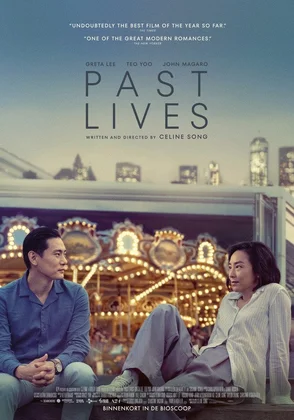
Past Lives takes place over 24 years, and delves into the longing between two childhood friends - Nora and Hae Sung. The story unfolds in fragments between childhood innocence, teenage distance, adult reconnection, all threaded together by the question of what might have been. It’s a film about timing, fate and the invisible strings that tie people together. The narrative guides us through the bittersweet ache of love that isn’t meant to be.
Thoughts
We all have that one person. The one from our past who still makes us wonder what might have happened if life had unfolded differently. Past Lives forces us to confront those feelings and watch them on a screen. It’s not afraid to have silences because it knows the watcher is experiencing emotions that fill it.
The opening scene immediately pulls you into its quiet, observational direction. We, as the watcher, are sitting on the opposite end of the dimly lit bar, looking towards Nora, Hae Sung, and Arthur from a distance. The camera lingers, zooming in slowly on Nora, letting us sit with the questions we have. You don’t hear their conversation at first. You just watch. It feels like you’re eavesdropping, trying to piece together who they are to each other based on soft glances and subtle shifts in their expressions.
It is an absolutely perfect opening to a movie whose whole emotional approach is full of unspoken meaning. It sets the tone for a story that’s less about what’s said and more about everything bubbling underneath.
Every single scene in this movie was done with deliberacy, and you can see this through the lighting. You can click on any second and analyse the lighting itself. The warmth of the sun shining through the curtains in the scenes when Nora and Hae Sung begin talking again, the cold dreariness in their lives when they cut off contact again. It’s perfectly done. Even in the quiet moments, you are being told how the characters feel through the shades surrounding them.
Past Lives is compact with visual metaphors that never call attention to themselves, but stay with you long after. The childhood moment of Nora climbing the stairs while Hae Sung lingers behind; it quietly marks the first split in their lives. Decades later, when they descend down the steps in New York, they stay on opposing sides of the bannister, repeating the image with a softer ache. It’s one of the many ways the film lets you pick up on its emotional echoes without ever spelling them out. It feels intentional in the best way.
Throughout the whole movie, the concept of “Inyeon” is mentioned by multiple characters. If you’re unfamiliar, Inyeon is a Korean concept (with roots in Buddhism) that refers to fate. Nora is the first one to Arthur, and she says, “It’s an inyeon if two strangers even walk past each other in the street and their clothes accidentally brush, because it means there must have been something between them in their past lives. If two people get married, they say it’s because there have been 8,000 layers of inyeon over 8,000 lifetimes.” This concept feels so fitting for this narrative, and the way it is weaved in and applied to all the characters really brings emotions onto the surface for you.
I can’t complete a review without mentioning how flawless the acting was in this movie. I especially loved John Magaro’s performance as Arthur. Although he doesn’t have as much screen-time as the others, how he played his role could have completely broken the narrative if he didn’t do it exactly the way he did. He represented American life. The American life that Nora wants for herself, and yet despite what he represented, he is still a character with depth. His own worries, struggles and emotions.
Recommendation
I highly recommend you watch this. This is the type of movie that sticks with you for while after you see it, and can make you think about life a little differently. Atleast, it certainly did for me. There aren’t any explicit scenes because it just isn’t that type of movie. It focuses on what is left unsaid, or undone, and what can never be done again.